RoundupVacuum Sealers
Best Vacuum Sealer for Home Use: 5 Honest Picks
24 min read
Read the guideComparison
We compared chamber and edge vacuum sealers on seal strength, bag costs, wet-food handling, reliability, and value. See which type wins for your kitchen.
We earn a commission if you buy through our links, at no extra cost to you. As an Amazon Associate, we earn from qualifying purchases. Scores and verdicts are set before any link is placed and never change after.
Quick answer
The food decides the type. Chamber machines like the Avid Armor USV20 seal liquids, marinades, and soups natively and run the cheapest pouch lane, which is why kitchens that seal wet food weekly go chamber.
Edge sealers like the FoodSaver FM2100 cost less up front, sit in a smaller body, and cover dry goods, meats, and sous vide duty for most households.
We compared both lanes on sealing durability, bag pricing, wet-food compatibility, dependability, and overall worth.
The chamber machine repays its higher price through pouch savings for anyone sealing large quantities on a regular rhythm; the edge machine wins on counter space and the first receipt.
When workspace is tight, the edge sealer stores far easier, at the cost of the freeze-first chore on wet loads.
Only the deltas that change how these two perform in your home, and what each one costs you in daily life.
Wet food handling
Chamber sealers can handle liquids, soups, and marinades without any prep work, while most edge sealers need liquids frozen first to keep liquid out of the pump.
Bag cost
The per-seal math decides this row: chamber pouches land at 3 to 8 cents apiece at case quantities against 25 to 45 cents for brand textured edge bags, which is roughly 100 to 200 dollars a year in savings for a household sealing ten bags a week.
Seal strength
Chamber sealing wins on consistency: the whole bag sits in the chamber, pressure equalizes around it, and owners report reliable, leak-free seals on wet loads, soups and sauces included, where edge machines fail. The FM2100 answers with its 14-seal endurance run, while the edge lane's strongest measured pull is the Nesco VS-12's 80 kPa (kilopascals, the pressure rating for suction strength).
Reliability
Chamber sealers are built for heavy-duty, long-term use with parts readily available. Edge sealers, especially popular models like the FoodSaver, can have a shorter lifespan under heavy use, with reports of pumps and heat strips failing after one to two years.
Initial price
Edge sealers are much cheaper to buy upfront, with the FoodSaver FM2100 at its verified 179.99 dollar price. Chamber sealers cost more initially, with the Avid Armor USV20 at 319 dollars, but can save you money on bags over time.
| Your use case | Winner | Why |
|---|---|---|
| Best for sealing liquids and soups | Avid Armor USV20 | The Avid Armor USV20 takes this job outright: liquids, marinades, and soups seal straight from the pot, no pre-freezing, no failed bags. Edge machines need the freeze-first step for the same loads, which is the whole difference in this lane. |
| Best for budget-conscious buyers | FoodSaver FM2100 | The FoodSaver FM2100 edge sealer has a much lower initial price at its verified 179.99 dollar list price. It is the best choice if you are on a budget and primarily seal dry goods. The edge sealer's lower upfront cost makes it more accessible for new users, and the 5 year warranty is the longest term on this page. |
| Best for frequent sealers and bulk cooks | Avid Armor USV20 | If you seal food frequently or in large batches, the chamber sealer's lower bag costs and heavy-duty build will save you money in the long run. Chamber pouches run 3 to 8 cents each at case quantities, while textured edge bags can cost 25 to 45 cents each, so a household sealing ten bags a week banks roughly 100 to 200 dollars a year on consumables by taking the chamber lane. |
| Best for sous vide and delicate foods | FoodSaver FM2100 | The FoodSaver FM2100's pulse mode and its accessory ecosystem make it the sous vide pick. The pulse mode meters the pull by hand so delicate loads stop short of crushing, and the same accessory port covers the marinating step of a bath-day routine through the included hose. The 5 year warranty backs the water-bath habit for half a decade. |
| Best for hunters and bulk season cooks | Avid Armor USV20 | Hunting forums recommend the chamber lane for fish and game season, where liquid marinades and bulk pouches are the weekly duty. The chamber sealer's native liquid handling and its lower bag costs make it the right lane for hunters who marinate and seal large quantities of game. |
| Best for small households with limited space | FoodSaver FM2100 | The FoodSaver FM2100 asks less of the counter than a chamber machine. It is not the compact lane at 16.3 by 9.2 by 4 inches, but the 4 inch height slips onto a cabinet shelf between sessions, where a chamber sealer's bulk and 17.55 pound weight tend to claim a permanent dedicated spot. |
| Best for long-term reliability and repairability | Avid Armor USV20 | Chamber sealers are built for the long haul and repair is part of the design. Owners describe it plainly: they stay in love with the machine for years, and when a part wears, the maker sells every replacement publicly, the most repeated durability line in the chamber threads. A worn gasket is an order and an afternoon, not a new machine. |
| Best for the ecosystem and accessories | FoodSaver FM2100 | The FoodSaver FM2100's accessory port and hose included for jars and containers make it a versatile choice for those who need more than just bag sealing. The jar and container ecosystem earns its keep: mason jar sealing, marinating canisters, and wine stoppers all run off the one accessory port. |
Both machines as ring gauges, then one radar shape: where each wins and where it gives ground, criterion by criterion.
| Score | 91 out of 100 |
|---|
Avid Armor USV20
| Score | 77 out of 100 |
|---|
FoodSaver FM2100
| Criterion | USV20 | FM2100 |
|---|---|---|
| Seal strength and consistency | 94 out of 100 | 90 out of 100 |
| Wet-food handling | 100 out of 100 | 68 out of 100 |
| Bag and roll economics | 98 out of 100 | 55 out of 100 |
| Reliability and build quality | 85 out of 100 | 82 out of 100 |
| Versatility and value | 80 out of 100 | 92 out of 100 |
Criterion by criterion
Both scores under every criterion, each bar filling left to right: the longer bar wins the row.
Seal strength and consistency
USV20 winsWet-food handling
USV20 winsBag and roll economics
USV20 winsReliability and build quality
USV20 winsVersatility and value
FM2100 winsThe two lanes differ by design: the FM2100 pulls air through a textured bag on the counter, while the USV20 seals the whole bag inside a vacuum chamber.
Modes, liquid handling, warranty terms, and the per-seal bag math follow from that one architectural difference.
| Spec | Avid Armor USV20 | FoodSaver FM2100 |
|---|---|---|
| RH score | 91/100 | 77/100 |
| Sealer Type | chamber vacuum sealer | countertop edge sealer with accessory port |
| Modes | 3 vacuum levels, 3 seal settings | dry, moist, pulse |
| Liquids | seals liquids and marinades natively | moist mode for damp foods; liquids need the freeze-first workaround |
| Warranty | 1 year | 5 years |
| Bag Cost | chamber pouch lane: roughly 3 to 8 cents per seal at case quantities | textured bag lane: roughly 11 to 45 cents per seal by bag choice |
| Dimensions | 14 x 12 x 8.25 inches | 16.3 x 9.2 x 4 inches |
| Live listing | Check Price at Amazon | Check Price at Amazon |
The long-term money lines: consumables, replacement parts, and the warranty years, so the purchase price is only half of what you will pay.
Initial purchase price
The FoodSaver FM2100 has a lower initial cost at its verified 179.99 dollar list price, making it more accessible for new users. The Avid Armor USV20 costs 319 dollars, a higher investment upfront.
Annual bag cost
For a household sealing ten bags a week, brand-name textured edge bags run roughly 130 to 235 dollars a year and generics cut that to about 55 to 130, while chamber pouches at 3 to 8 cents a seal run about 15 to 40 dollars a year. That swing repays the USV20's roughly 139 dollar premium over the FM2100's 179.99 dollar price in about eight months to a year and a half at the brand-bag lane.
Warranty coverage
The FoodSaver FM2100 comes with a 5 year limited warranty, the longest in this comparison. The Avid Armor USV20 states a 1 year warranty, so the longer term is the edge machine's card here, weighed against the chamber machine's public parts catalog.
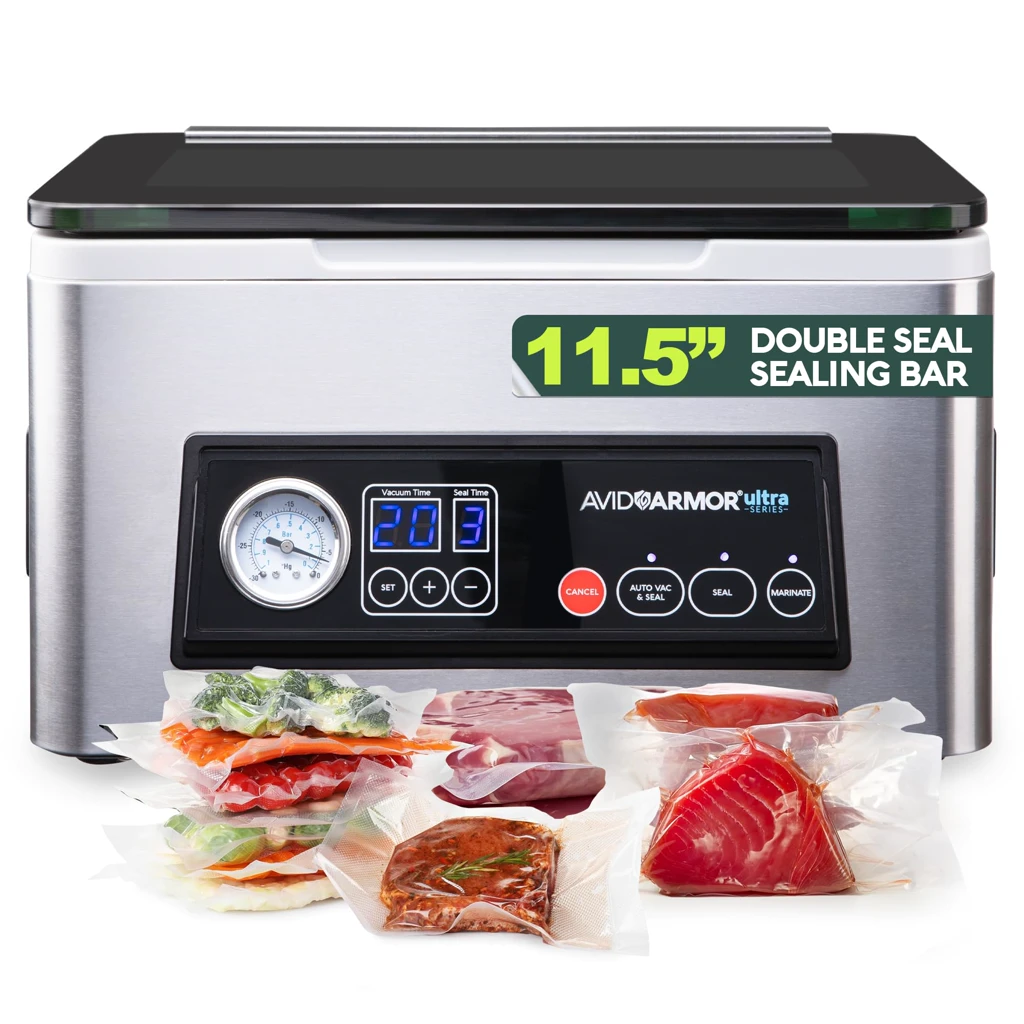
What USV20 owners say
Owners love
Owners complain about
| Spec | Value |
|---|---|
| Model | USV20 |
| Sealer Type | chamber vacuum sealer |
| Seal Bar | 11.5 inch double seal bar |
| Chamber Size | 4 liter chamber |
| Bag Compatibility | any smooth chamber pouch, no textured bags required |
| Liquids | seals liquids and marinades natively |
| Parts | maker sells every spare part publicly |
| Warranty | 1 year |
| Dimensions | 14 x 12 x 8.25 inches |
| Weight | 17.55 lb |
| Modes | 3 vacuum levels, 3 seal settings |
| Kit | starter pack of chamber pouches, accessory hose, quick-start guide |
| Accessory Port | yes, hose for jars and canisters included |
| Bag Cost | chamber pouch lane: roughly 3 to 8 cents per seal at case quantities |
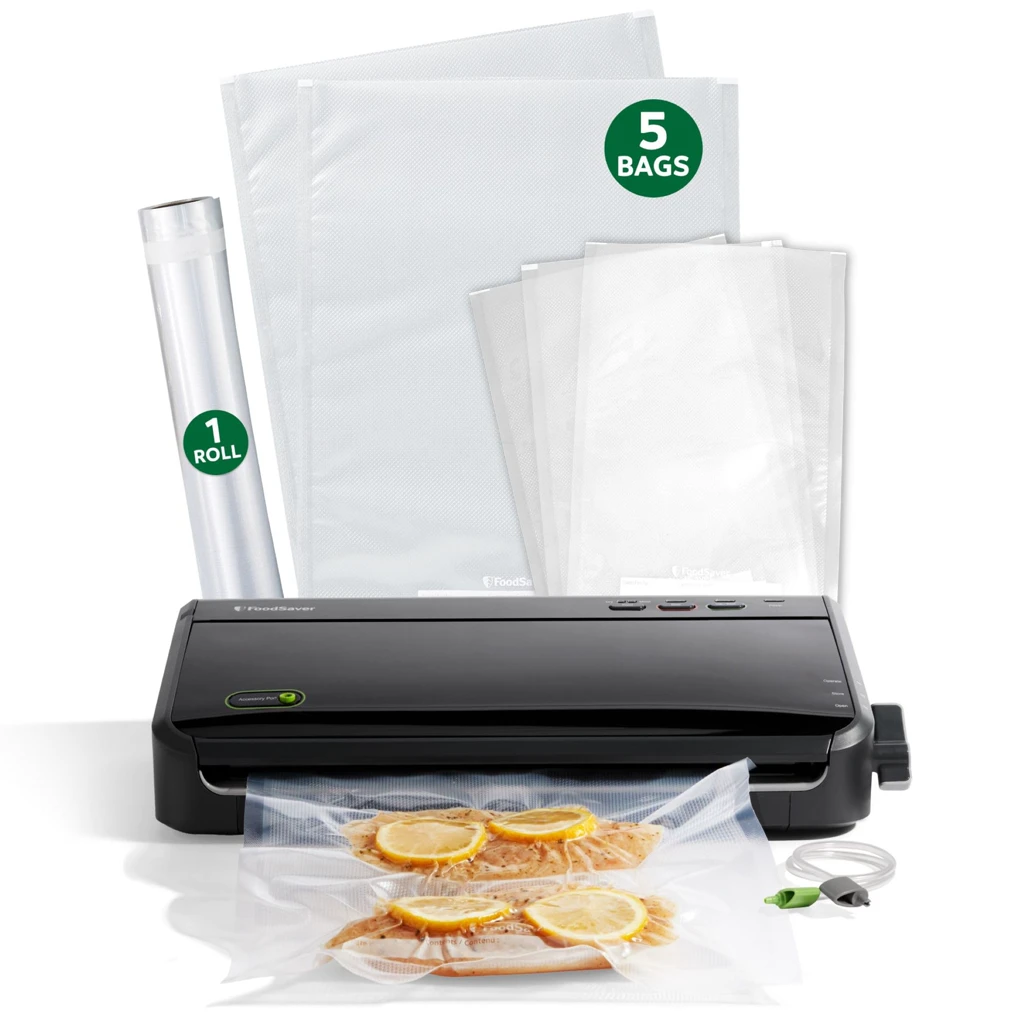
What FM2100 owners say
Owners love
Owners complain about
| Spec | Value |
|---|---|
| Model | FM2100 |
| Sealer Type | countertop edge sealer with accessory port |
| Power | 120 watts |
| Dimensions | 16.3 x 9.2 x 4 inches |
| Modes | dry, moist, pulse |
| Roll Storage | built-in roll storage and cutter bar |
| Accessory Port | yes, hose included for jars and containers |
| Kit | starter bags and one roll included |
| Warranty | 5 years |
| Consecutive Seals | 14 seals without a miss in The Barbecue Lab endurance count |
| Liquids | moist mode for damp foods; liquids need the freeze-first workaround |
| Vacuum Strength | no published figure; endurance proven at 14 consecutive seals |
| Bag Cost | textured bag lane: roughly 11 to 45 cents per seal by bag choice |
The honest tie conditions: which reader each machine wins, and the cases where either is right.
Choose the Avid Armor USV20 chamber sealer if you regularly seal liquids, soups, or marinades and want the lowest long-term bag costs.
Choose Avid Armor USV20Choose the FoodSaver FM2100 edge sealer if you have a tighter budget and primarily seal dry goods, or use it for sous vide.
Choose FoodSaver FM2100Choose the chamber sealer if you seal food very frequently: its lower pouch cost pays back the initial price difference over several years.
Choose Avid Armor USV20Choose the edge sealer if counter space is limited, because the more compact body stores easier, though chamber models still handle wet foods better.
Choose FoodSaver FM2100Choose the chamber sealer if you are a hunter or bulk season cook who marinates and seals large quantities of game: its liquid handling and capacity take the load.
Choose Avid Armor USV20Choose the edge sealer if you need one machine for jars, marinating, and wine preservation beyond bags: its accessory ecosystem is the more versatile lane.
Choose FoodSaver FM21009 models scored across 5 criteria, from 8 verified sources.
Read the makers' product pages and documentation
Every spec starts at the source: the live listing read for sealer type, power, dimensions, warranty term, and kit contents, with the maker's own claims about liquid sealing and bag compatibility recorded as claims, not verdicts.
Both machines' stated capabilities then sit on the same footing before any outside evidence weighs in.
Set the independent lab data side by side
The independent labs' numbers sit beside the maker claims: shouldit measured vacuum strength in kPa for the edge machines, which is how the Nesco VS-12's 80 kPa reading stands against the FoodSaver FM2100's endurance record.
Lab data moves past manufacturer claims, and this pair needed exactly that, since one maker publishes no suction figure at all.
Read the owner reviews in bulk
We read the owner pools in bulk, Amazon reviews plus the Reddit and Facebook threads, and logged the praise and complaints that repeat: FoodSaver owners report a death cycle of one to two years under heavy use, while chamber owners report soups and sauces sealing reliably where their old edge machines failed.
The long-run failure modes and the features owners actually use show up there, not in the spec sheets.
Weigh the per-seal bag costs
We researched the long-term costs of each sealer type by calculating the price per seal for both edge and chamber bags.
Textured edge bags run 25 to 45 cents each at brand retail against 11 to 25 cents for generic equivalents, while chamber pouches run 3 to 8 cents at case quantities.
That per-seal math is the number a frequent sealer actually lives with, because bags are the expense that never stops after the machine is paid for.
Check reliability and repair paths
We evaluated each sealer's reliability based on warranty length, owner reports of failure modes, and the availability of replacement parts.
Chamber sealers scored higher here due to their heavy-duty build and readily available parts, while edge sealers had more reports of pump and heat strip failures.
A sealer's reliability is a key factor in its long-term value, as a machine that fails frequently or cannot be repaired easily will end up costing more in the long run.
Compare the ecosystem and accessory lanes
We examined the accessory ecosystem around both machines: the jar and canister fittings, the hose options, and the bag formats each accepts.
The FoodSaver FM2100 carries the accessory port and hose for jars and containers, which makes it the flexible pick for kitchens that seal beyond plain bags, while the chamber lane counters with its cheap smooth-pouch supply instead of an attachment catalog.
Comparing the full capability of each machine, not just the sealing bar, is what rounds out the verdict for multi-use kitchens.
Every figure on this page traces to a dated source: verified listing data, independent lab results, and owner reports read in bulk. The full methodology and scoring weights live on the how we evaluate page.
For a kitchen sealing mostly dry goods a few times a week, the edge machine wins on price and storage: the FoodSaver FM2100 at its verified 179.99 dollar list price.
For a kitchen that seals soups weekly, marinates in bulk, or hunts, the chamber machine is the buy: the Avid Armor USV20 at 319 dollars with case-quantity pouches at 3 to 8 cents. The verdict table above routes each condition to its machine.
Edge sealers generally struggle with direct liquid contact. You usually must pre-freeze liquids to avoid pump suction issues that lead to sealing problems.
Chamber sealers, conversely, can handle liquids and marinades without requiring any special preparation.
Yes, if you seal liquids frequently or seal in large batches. The lower cost of chamber pouches (3 to 8 cents each) compared to edge bags (25 to 45 cents each) can save you a significant amount of money over time, offsetting the higher initial price.
In short, the pricier one is worth it for a wet, high-volume kitchen and is not for a dry-goods household that seals a bag or two a month.
Sealing load sets the answer.
The record carries no light-duty average for either architecture: its gentle-duty anchors are the 5 year warranty FoodSaver writes on its edge flagships, the lid gasket that compresses inside its first three years as the upkeep rhythm, and a lone near-decade FoodSaver in the sous vide threads.
Heavy batch duty wears edge machines down in one to two years, the death-cycle reports with pumps and heat strips named, while chamber machines carry the parts-on-demand record that stretches service further.
The warranty term is the maker's own prediction of the lane you will land in.
Chamber sealers generally outlast edge machines under heavy duty: the build is heavier, the chamber design shrugs off liquids that stress edge pumps, and every spare part is on public sale.
Edge sealers hold up fine on lighter schedules but age faster under constant heavy use.
Yes, when the sealing rate pays for the bag bill.
At ten seals a week the consumables run roughly 130 to 235 dollars a year on brand-name edge bags, 55 to 130 on generics, and 15 to 40 on chamber pouches, so the lane you pick swings the yearly bag bill by about 100 to 200 dollars before any food savings count, and the research record puts those food savings at 300 to 850 dollars a year for active households.
The best vacuum sealer roundup carries the per-machine worked math.
One architecture decision splits them: an edge machine evacuates through the bag itself, so it needs textured bags and struggles with moisture, while a chamber machine seals the bag inside a vacuum chamber, so liquids, marinades, and cheap smooth pouches all work.
Everything else, from the duty cycle to the counter footprint, follows from that difference.
They need smooth pouches, not the textured bags edge machines live on. Any plain chamber pouch seals, and at restaurant-supply case quantities they run 3 to 8 cents against 25 to 45 cents for brand-name textured bags, so the bag bill drops hard.
The one planning note: branded pouches at consumer prices are the expensive lane, and chamber owners order restaurant-supply cases instead.
You are reading the quick version. Switch to Full guide for the complete comparison table, buying guide, and frequently asked questions.
Mara Whitfield writes the how-to and worth-it side of the bench: the step-by-step method guides, the usage logs, and the honest cost-per-year math behind every worth-it verdict.
She keeps a running pantry of 400-plus sealed jars and a usage log for every appliance on the bench, and her guides carry the failure modes first because she has hit most of them. She raises dairy goats and puts up the harvest on a five-acre homestead.
RoundupVacuum Sealers
ComparisonVacuum Sealers
FixVacuum Sealers
Analytics consent
We use Google Analytics to count page views, anonymously and only after your consent. No ads, no profiles, no data sales. Declining keeps everything off.