ComparisonVacuum Sealers
FoodSaver FM2100 vs Nesco VS-12: The Honest Head-to-Head
11 min read
Read the guideReview
Our close look at the FoodSaver FM2100 vacuum sealer: a 5 year warranty, 14-seal endurance, and jar sealing, weighed against its wet-food limits.
We earn a commission if you buy through our links, at no extra cost to you. As an Amazon Associate, we earn from qualifying purchases. Scores and verdicts are set before any link is placed and never change after.
Quick answer
| Score | 77 out of 100 |
|---|
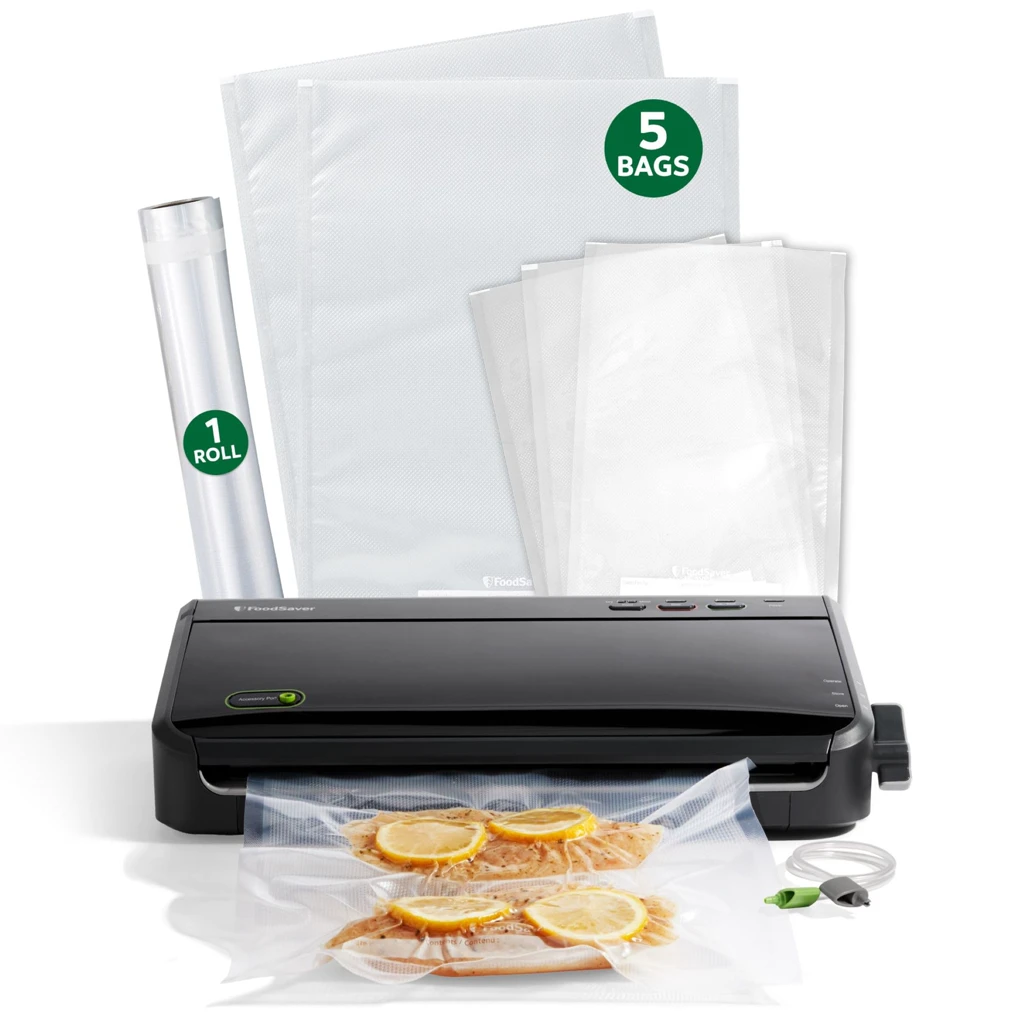
The FoodSaver FM2100 is the edge sealer to buy when you want the whole ecosystem at its verified 179.99 dollar price: a 5 year limited warranty tied for the longest stated term in this comparison, a built-in roll storage and cutter bar, and an accessory port with hose that seals jars and containers, runs the marinating canister, and takes a wine stopper.
Score 77 out of 100, the same single-sourced number the roundup and the database carry.
Who it is for: Busy households that seal most weeks: bulk buyers splitting warehouse hauls, gardeners freezing harvests, and sous vide cooks, one of whom logged almost ten years of venison duty on this line. The 5 year limited warranty, the roll storage and cutter, and the accessory port for jars and containers are the flagship feature set that the mid-range money buys here.
Who should skip: Skip it if soups, sauces, and marinades are most of your sealing: moisture in the seal zone defeats edge machines, and the official answer is freezing liquids first, which is a chore on soup night. Heavy batch households should also read the death-cycle reports before spending at this band.
Brand: FoodSaver
Price: $179.99
(Price fact-checked - Details)
16.3 x 9.2 x 4 inches120 watts5 yearscountertop edge sealer with accessory portdry, moist, pulse
What could go wrong5
What works5
Every value on this sheet is fact-checked against primary sources, and the full source record ships with the page's machine-readable data layer.
| Spec | Value |
|---|---|
| Model | FM2100 |
| Sealer Type | countertop edge sealer with accessory port |
| Power | 120 watts |
| Dimensions | 16.3 x 9.2 x 4 inches |
| Modes | dry, moist, pulse |
| Roll Storage | built-in roll storage and cutter bar |
| Accessory Port | yes, hose included for jars and containers |
| Kit | starter bags and one roll included |
| Warranty | 5 years |
| Consecutive Seals | 14 seals without a miss in The Barbecue Lab endurance count |
| Liquids | moist mode for damp foods; liquids need the freeze-first workaround |
| Vacuum Strength | no published figure; endurance proven at 14 consecutive seals |
| Bag Cost | textured bag lane: roughly 11 to 45 cents per seal by bag choice |
The numbers first.
The FM2100 draws 120 watts, and FoodSaver publishes no kPa suction figure for it, so the endurance record is the performance evidence that matters: The Barbecue Lab's test logged 14 consecutive seals without a single failure, which says the seal bar holds its heat and the pump holds its pull through a real session.
The mode set is dry, moist, and pulse, the roll storage and cutter bar are built in, and the whole machine measures about 16.3 by 9.2 by 4 inches. In daily use it earns its keep on the freezer math.
Owner threads report sealed ribeyes still tasting excellent after about two years with no freezer burn, which matches the brand's 2 to 3 year freshness guidance, and bulk buyers call the machine a game changer for meal prep and warehouse runs, working it almost every other day.
One sous vide cook logged almost ten years of venison duty before the pump quit, the top end of the owner record. The accessory port is what separates it from cheaper edge sealers.
The included hose drives jar sealers for pantry goods, marinating containers, and wine stoppers, so one machine covers the bags, the mason jars, and the open bottle, which is why sous vide cooks and bulk preppers keep choosing it.
Paired with the roll storage and cutter, the FM2100 works as the hub of a storage system rather than a single-job appliance. Then the trade-offs, which are real.
Wet food is the weak point: edge sealers pull air through the textured bag, moisture in the seal zone kills the seal, and the brand's own answer is freezing liquids solid first, the step the wet-food threads repeat.
Heavy batch users report a death cycle of one to two years, with the pump, heat strips, and solenoids as the named failure parts, so the 5 year limited warranty is doing real work in that lane even as it cannot erase the waiting.
The duty cycle stalls marathons too: 20 seconds between seals and a 20 minute cooldown when the pump runs long. The Barbecue Lab's endurance run counted 14 consecutive seals, and that count stands as the machine's published endurance record.
The recurring cost is the bag lane: brand textured bags run 25 to 45 cents each against 11 to 25 cents for generics, so the cheap lane exists but wants a trial pack first. The maintenance record is the part owners learn late.
The brand's own troubleshooting guide names the compressed foam lid gasket as the cause when the unit seals but stops vacuuming, and gasket wear is the year-one to year-three failure in the long threads, so a two-minute gasket check each season keeps the pull honest.
The rest of the care list is short: wipe the sealing strip after each session and give every seal its rest. Owners who keep that list report the machine outliving the warranty term; owners who run marathon batches against the duty cycle do not.
| Criterion | FM2100 |
|---|---|
| Seal strength and consistency | 90 out of 100 |
| Wet-food handling | 68 out of 100 |
| Bag and roll economics | 55 out of 100 |
| Reliability and build quality | 82 out of 100 |
| Versatility and value | 92 out of 100 |
Score breakdown
77/100 overall
Seal strength and consistency
90/100
Wet-food handling
68/100
Bag and roll economics
55/100
Reliability and build quality
82/100
Versatility and value
92/100
Field context: best 91, average 71, across 9 scored vacuum sealers
What FM2100 owners say
Owners love
Owners complain about
The FoodSaver FM2100 is the edge sealer to buy when you want the whole ecosystem at its verified 179.99 dollar price: a 5 year limited warranty tied for the longest stated term in this comparison, a built-in roll storage and cutter bar, and an accessory port with hose that seals jars and containers, runs the marinating canister, and takes a wine stopper.
FoodSaver publishes no kPa figure (kilopascals, the pressure number independent labs use to rate a sealer's suction) for the pull, and the strongest published performance record is The Barbecue Lab's endurance run: 14 consecutive seals without a miss.
The honest limits are wet food and batch duty.
Moisture in the seal zone kills edge seals, so soups and marinades want the freeze-first workaround the brand's own guides teach, and heavy users report the pump, heat strips, or solenoids dying on a one to two year cycle under batches.
The manual's duty cycle also stalls marathon sessions: each seal wants its 20 second pause, and once the pump has run long, the machine asks for 20 minutes of rest.
The call: buy it for a household that seals dry goods, meats, and jars most weeks and wants the 5 year warranty lane behind the machine.
If your sealing is mostly liquids, or you run big batches daily, a chamber machine takes that job and holds the line longer.
Buy it if: Busy households that seal most weeks: bulk buyers splitting warehouse hauls, gardeners freezing harvests, and sous vide cooks, one of whom logged almost ten years of venison duty on this line. The 5 year limited warranty, the roll storage and cutter, and the accessory port for jars and containers are the flagship feature set that the mid-range money buys here.
Skip it if: Skip it if soups, sauces, and marinades are most of your sealing: moisture in the seal zone defeats edge machines, and the official answer is freezing liquids first, which is a chore on soup night. Heavy batch households should also read the death-cycle reports before spending at this band.
The overall score is the straight average of five equally weighted criteria: Seal strength and consistency, Wet-food handling, Bag and roll economics, Reliability and build quality, Versatility and value.
9 models scored across 5 criteria, from 10 verified sources.
Build the verified record
Every machine starts as a research record: the live listing read for power draw, dimensions, mode list, warranty term, and kit contents, each figure with its source beside it. A claim only the maker stands behind carries the maker-stated label.
Line up the independent labs
The lab numbers sit beside the maker claims: shouldit measured the Nesco VS-12 at 80 kPa and the MEGAWISE at 43 against its own 80 kPa claim, and The Barbecue Lab counted 14 consecutive FoodSaver FM2100 seals without a miss.
Where a lab and a listing disagree, both figures stay in the record.
Read the owners in bulk
We worked through the owner pools by the hundreds, Amazon reviews plus the long-term threads from r/sousvide, r/Frugal, and r/Cooking, and logged what repeats: gaskets that compress, pumps that die on batch duty, machines that outlive their warranty terms.
One complaint is one owner's bad week; the same complaint across hundreds of owners is a pattern the record keeps.
Read the incumbents for the gaps
The ranking pages from Serious Eats, Wirecutter, and The Barbecue Lab were read for their testing criteria and their picks.
The record behind the machines we compared agrees with those picks where it holds up and parts ways where it does not, on the cost-per-seal math and the rating-pool honesty the incumbents skip.
Hold the demand bar
Every pick had to carry a well-rated owner review record on its live listing before it earned a slot, because a thin or poorly-rated pool is the market itself saying no.
A famous critics' pick stays out entirely: Serious Eats ranks the Anova Precision Pro ANVS02 its number one edge pick while the machine's Amazon owner pool sits below the 4.0 floor a recommendation must respect.
Work the per-seal math
The bag bill runs per machine: brand textured bags at 25 to 45 cents a seal, quality generics at 11 to 25, chamber pouches at 3 to 8 cents at case quantities, all at a ten-seal-a-week rhythm.
For high-volume households the economics pick the winner more often than the sticker does.
Every figure on this page traces to a dated source: verified listing data, independent lab results, and owner reports read in bulk. The full methodology and scoring weights live on the how we evaluate page.
ComparisonVacuum Sealers
ComparisonVacuum Sealers
RoundupVacuum Sealers
It splits cleanly on batch load.
The record holds no light-duty average: what it carries for gentle work is the 5 year warranty, the maker's bet that the machine outlasts gentle service, the gasket that compresses across the years-one-to-three stretch as the honest maintenance rhythm, and a single sous vide cook who pushed venison through this line for nearly a decade before the pump quit, the one long-run owner the threads name.
Heavy batch duty is the other lane: owner threads report machines failing every one to two years, with the pump, the heat strips, and the solenoid valves as the parts that go.
That record is why the warranty term matters: light users rarely need it, and heavy users live inside it. Match the machine to your batch size and the numbers work.
Not directly. As an edge sealer it pulls air through the textured bag, and liquid rides that airflow into the seal zone, so the heat strips cannot bond the bag shut.
The brand's own troubleshooting guides teach the workaround: the card says freeze solid, while the tested window is the slush, thick enough to hold at the seal and never a brick. Either way it adds a real step on soup night.
If sealing liquids directly is the main job, a chamber sealer takes it: the whole bag sits inside the chamber, the air comes from around the bag, and soups seal with no freeze step. Our chamber-versus-edge page lays out that lane in full.
The box carries a starter kit: a selection of pre-cut bags in various sizes plus one roll, enough for the first several sealing sessions.
The warranty is the headline at 5 years limited, and the lead is real but narrower than it looks: the FoodSaver VS100 sibling matches the 5 years, so the daylight opens against the 1 year Nesco VS-12, the 2 year Anova Slim, and the budget imports that state no term.
That coverage is why mid-range money buys the flagship feature set on this counter: even the heavy-batch failure reports land inside the term.
The warranty story is a family tie at the top, with the real gap showing against the short-term machines, not against the cheaper FoodSaver.
Brand-name FoodSaver textured bags run 25 to 45 cents each at retail, the most expensive lane with no recorded seal advantage over a quality generic.
At about ten seals a week, that is roughly 130 to 235 dollars a year, the ongoing cost that draws the most complaints in owner threads. Generic bags cut the bill to 11 to 25 cents a seal, and most long-term owners settle into them after testing a pack.
The generic lane is where the long-run math lands: owner threads call it the biggest single cost cut a FoodSaver owner can make, the gap between an appliance you keep feeding and one that quietly pays for itself. The cheaper lane works; it just wants a trial run first.
Both are FoodSaver edge sealers, but they aim at different counters. The FM2100 is the flagship: built-in roll storage and a cutter bar for custom bags without scissors, the accessory port and hose for jars and containers, and the 5 year warranty.
The VS100 is the compact budget sibling: same ecosystem and warranty, no roll storage, and a smaller body.
The measured pull differs too: shouldit, an independent product-testing lab, logged the VS100 at 62 to 64 kPa, while the FM2100 publishes no figure but carries The Barbecue Lab's 14 seal endurance run.
Buy the VS100 for a small counter and weekly duty; buy the FM2100 when jars and roll cutting are weekly work.
The honest answer is that the record cannot rank it. FoodSaver publishes no decibel figure for the FM2100, so the site carries no noise record for this machine.
The one measured number in the class belongs to the Nesco VS-12: shouldit logged 83.4 dBA (A-weighted decibels, the loudness reading calibrated to the ear; higher numbers mean louder), the loudest reading in that comparison.
Whether the FM2100 hums like a countertop appliance or screeches near that measured pole is a question the record cannot answer yet, so a noise-sensitive kitchen has no number to lean on here and should plan big batches for waking hours.
The dry setting is the default for solid foods: a full vacuum pull and a standard heat seal for meats, vegetables, dry goods, and leftovers with little free liquid.
The moist setting is for damp foods: marinated meats, fatty cuts, and dishes with surface liquid, and it draws a gentler vacuum with a longer seal time so liquid stays in the bag instead of riding into the seal zone.
The pulse setting is the third mode, and it is the crush control: tap the button and the vacuum runs only while you hold it, which is how berries, bread, and delicate fish survive.
Managing liquid is the moist mode's job; protecting crushable food belongs to the pulse button.
In practice the split reads plainly: dry for grains and leftover roast, moist for marinated meats and damp vegetables, pulse for the foods a full pull would flatten.
Yes, with a test pack first. The FM2100 seals any bag built with the textured-channel design, and quality generics at 11 to 25 cents each are the lane most long-term owners settle into.
The honest caveat: the very cheapest generics vary. Some seal perfectly, others are thinner, puncture easier, or carry weaker air channels, so run one pack before committing to a brand.
A single evening settles it: seal three bags, freeze one, squeeze the rest after a week, and at that price the failures show up fast without costing much. Owner threads consistently name generic textured bags as the biggest cost cut a FoodSaver owner can make.
The short list: wipe the sealing area with a damp cloth after each use and check the foam lid gasket periodically for crumbs, wear, or damage, because a compromised gasket kills the vacuum.
The discipline that matters most is the rest rule: 20 seconds between bags, and once the pump has run long, a 20 minute cooldown before the next session. Back-to-back marathon sessions are how the pumps in the failure threads died early.
Two honest lanes cover most kitchens: the FoodSaver VS100 at 84.67 dollars for a small counter and weekly bag duty, and this FM2100, whose verified list price is 179.99 dollars, when the built-in roll cutter, the jar port, and the 5 year warranty earn the extra money that makes an expensive sealer worth it.
When those extras would sit unused, the cheaper lane is the smarter buy, so whatever the budget, check the warranty term and the parts story before buying: the lid gasket and the heat strip are the two wear parts, and a maker that sells them cheaply keeps a sealer alive.
You are reading the quick version. Switch to Full guide for the complete comparison table, buying guide, and frequently asked questions.
Daniel Reyes runs the Rated Hive bench: the spec tables, the score breakdowns, and the verification log behind every review.
He compiles the verified spec record for every product from manufacturer documentation and live listings, re-verifies the money pages quarterly, and writes the honest verdicts, limitations first.
He lives on a two-acre homestead and preserves the harvest he grows.
RoundupVacuum Sealers
FixVacuum Sealers
FixVacuum Sealers
Analytics consent
We use Google Analytics to count page views, anonymously and only after your consent. No ads, no profiles, no data sales. Declining keeps everything off.